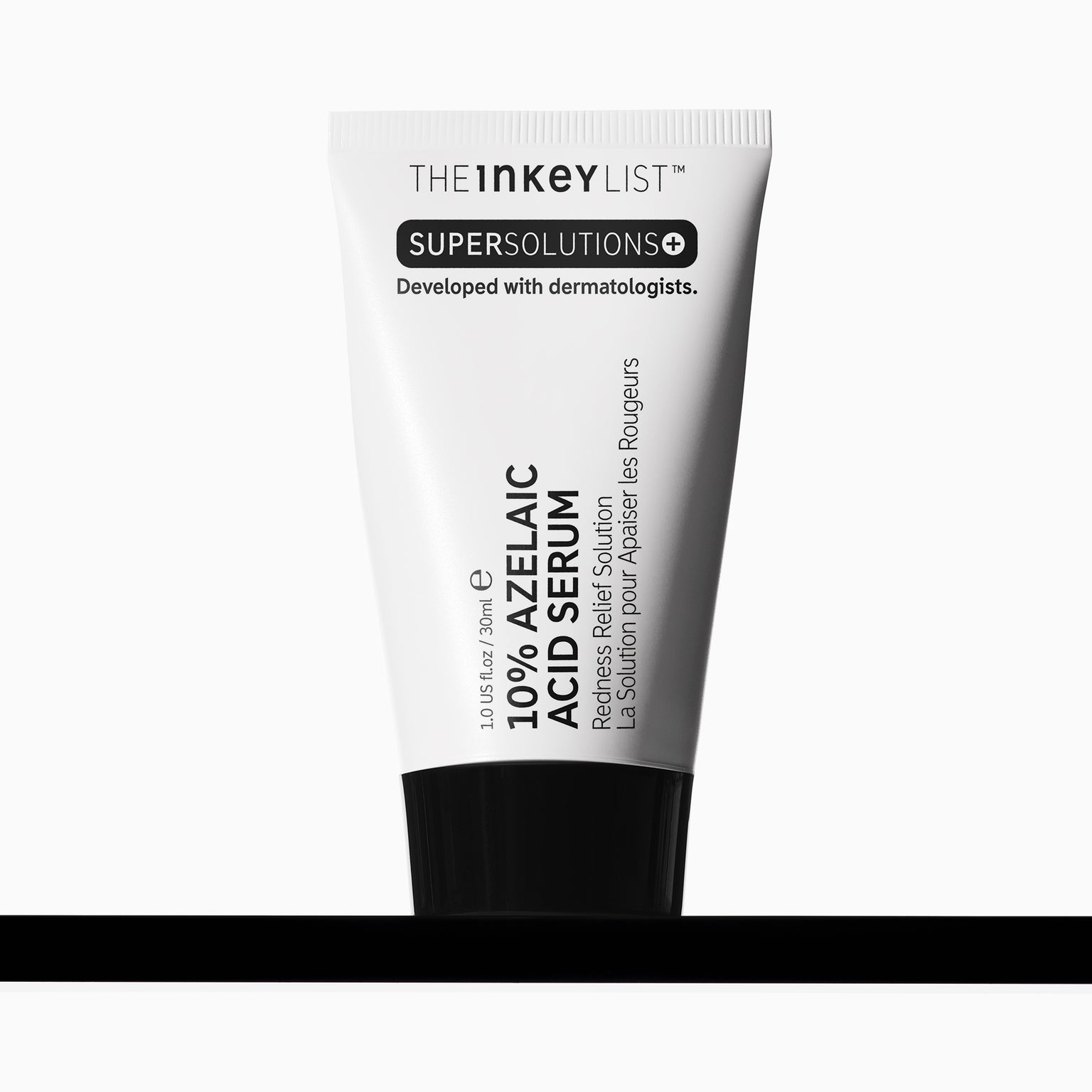
Yes, you can use azelaic acid and retinol in the same routine — though how you combine them matters, and you may have seen conflicting advice on this. Some sources recommend keeping them in separate routines, others say layering them together is fine. Both positions have merit, and the right approach depends on your skin, your concentrations, and how long you've been using each ingredient. What's clear is that these two actives complement each other well — they work through entirely different mechanisms, and dermatologists frequently prescribe them together for acne, rosacea, and hyperpigmentation. The question isn't whether to use both, but how to introduce them in a way that works for your skin.
Why This Combination Works
Azelaic acid is a dicarboxylic acid — not an AHA, not a BHA, and not a traditional exfoliant. It works through a distinct set of mechanisms: inhibiting tyrosinase (the enzyme responsible for excess melanin production), reducing inflammation, killing acne-causing bacteria, and normalising keratin production inside pores. Retinol, meanwhile, accelerates cell turnover, stimulates collagen synthesis, and refines skin texture by promoting the shedding of dead cells from the surface.
Because these two ingredients work through entirely different pathways, they don't compete with each other the way that, say, two exfoliants might. Azelaic acid targets pigmentation and bacteria at the cellular level. Retinol remodels the skin from deeper within the dermis. Together, they address a broader range of concerns than either ingredient can manage alone — without the redundancy that makes some combinations unnecessarily harsh.
Azelaic acid and retinol work through entirely different pathways — one targets pigmentation and bacteria, the other drives cell turnover and collagen. That's why dermatologists pair them: different mechanisms, shared goals, minimal overlap in how they challenge the skin.
Why You'll Find Different Advice Online
If you've searched this question before, you've probably found contradictory answers. Many skincare resources advise against layering any two actives in the same routine — and that's not unreasonable as a general rule. Combining potent ingredients increases the risk of irritation, and for pairings like retinol with AHAs or pure L-ascorbic acid, the pH conflict and irritation overlap are real concerns. The blanket 'don't mix actives' advice exists because it's the safest default for the widest audience.
Azelaic acid, however, is different from most actives in a few important ways. It's a dicarboxylic acid — not an AHA, not a BHA, and not a traditional exfoliant. Its formulations typically sit at a pH of 4 to 5, which is close to the skin's natural pH and within the range where retinol remains stable (pH 5.5 to 6). That's a much narrower gap than, say, L-ascorbic acid (pH 2.5 to 3.5) versus retinol. It's also genuinely anti-inflammatory, which means it doesn't add to the irritation load the way most other actives do.
This is why dermatologists frequently prescribe azelaic acid and retinoids together — including prescription-strength tretinoin with 15% azelaic acid for acne and rosacea patients. That clinical context is worth noting, because it tells us the combination has been used under medical supervision with good outcomes. It doesn't mean same-routine layering is right for everyone, but it does mean the pairing itself is well-established rather than experimental.
Who Benefits Most from This Combination
Acne and post-acne marks. If you're dealing with active breakouts and the dark spots they leave behind, this is an ideal pairing. Retinol prevents new breakouts by keeping pores clear through accelerated cell turnover. Azelaic acid tackles the hyperpigmentation left by old breakouts while also providing antibacterial action against current ones. The two ingredients attack acne from different angles — retinol on the structural side, azelaic acid on the bacterial and pigmentary side.
Rosacea-prone skin. This is where azelaic acid truly distinguishes itself. It's one of the few actives that's both effective for rosacea and well-tolerated by rosacea-prone skin — in fact, prescription azelaic acid (15% Finacea gel) is a first-line rosacea treatment. If you have rosacea but also want the anti-ageing and texture-refining benefits of retinol, azelaic acid is the companion active that won't tip your skin over the edge. It's anti-inflammatory properties can actually help buffer some of the irritation that retinol can cause.
Melasma and stubborn pigmentation. Azelaic acid inhibits tyrosinase — the enzyme that drives melanin overproduction — while retinol speeds up the turnover of pigmented surface cells. This dual approach addresses hyperpigmentation at both the production and removal stages, which is why dermatologists often prescribe the combination for melasma alongside sun protection.
For rosacea-prone skin that wants the benefits of retinol, azelaic acid isn't just a safe companion — it's the ideal one. Its anti-inflammatory action can actually help offset retinol's irritation potential.
The Recommended Approach: AM/PM Split
The simplest and most universally safe way to use both ingredients is to split them across your morning and evening routines. Use azelaic acid in the morning — it's not photosensitising and pairs well with SPF — and retinol in the evening, where it belongs because of its photosensitivity. This gives each ingredient uninterrupted contact with the skin, keeps the total active load per routine low, and eliminates any question about layering compatibility. If you're new to either ingredient, or if your skin is sensitive or reactive, this is the approach to start with and the one most dermatologists would recommend as a default.
The AM/PM split is also the approach that aligns with the cautious advice you'll find elsewhere online. When sources say 'don't use these together,' they often mean 'don't layer them in the same application step' — and separating them across routines honours that caution while still getting the full benefit of both ingredients. For many people, this is the right long-term approach, not just a stepping stone.
Start with the AM/PM split. It's the safest default, it works for all skin types, and it gives each ingredient the best chance to do its job without interference.
Same Routine: When It Can Work
Some people do use azelaic acid and retinol in the same evening routine — and for established, tolerant skin at moderate concentrations, this can work well. The pH compatibility between the two is closer than most active pairings, and azelaic acid's anti-inflammatory profile means it doesn't compound retinol's irritation the way AHAs or BHAs would. Dermatologists prescribe the combination for same-routine use in clinical settings, which suggests it's not inherently problematic.
That said, same-routine layering is the advanced option, not the starting point. Consider it only if you've been using both ingredients separately for at least six to eight weeks with no irritation, you're using OTC concentrations (10% azelaic acid or lower, 0.5% retinol or lower), and your skin barrier is healthy. Apply the thinner product first — usually the retinol serum — let it absorb for a minute or two, then follow with the azelaic acid. If you notice any increase in redness, stinging, or dryness compared to using them separately, go back to the AM/PM split. There's no prize for layering them together, and no penalty for keeping them apart.
Building Tolerance: The Introduction Schedule
If you're new to both ingredients, don't start them simultaneously. Introduce one first, build tolerance over four to six weeks, then add the second. Retinol typically requires the longer adjustment period — start with a low concentration (0.1% to 0.3%), two to three evenings per week, and increase frequency gradually. Once your skin has stabilised with retinol, adding azelaic acid is usually straightforward because it's one of the least irritating actives available.
If you're already using retinol and want to add azelaic acid, start with the AM/PM split: azelaic acid in the morning, retinol in the evening. Begin with the lower OTC concentration (10%) and use the azelaic acid every other morning for the first two weeks. If your skin tolerates this well — no persistent redness, stinging, or dryness — move to daily morning use. Most people find azelaic acid causes nothing more than mild tingling on first application, which typically resolves within the first week or two. Stay with the AM/PM split unless you have a specific reason to consolidate them into one routine.
Concentrations and What to Look For
Azelaic acid is available over the counter at up to 10% in the UK and EU, and at prescription strengths of 15% (gel) and 20% (cream). For combining with retinol, 10% OTC formulations are the practical starting point. The prescription strengths are more potent and are typically used as standalone treatments for acne or rosacea under medical supervision — combining prescription-strength azelaic acid with retinol should be guided by a dermatologist.
For retinol, the same concentration guidance applies as with any retinol routine: 0.1% to 0.3% for beginners, 0.3% to 0.5% for intermediate users, and 0.5% to 1% for experienced retinol users. When combining with azelaic acid, there's no need to adjust your retinol concentration downward — the two ingredients don't amplify each other's irritation the way that retinol and AHAs can.
What About Other Actives in the Same Routine?
Niacinamide is an excellent addition to a routine that includes both azelaic acid and retinol. It strengthens the skin barrier, reduces redness, and supports both ingredients' brightening effects. Many azelaic acid formulations already contain niacinamide, which is a good sign that the cosmetic chemistry community considers them compatible.
Be more cautious about adding AHAs, BHAs, or pure vitamin C to the same routine step. While azelaic acid plays well with most actives, stacking three or four potent ingredients in a single routine can overwhelm even resilient skin. If you want to include an exfoliating acid, use it on alternate days to the retinol, or limit it to a weekly treatment rather than a daily layer.
Azelaic acid, retinol, and niacinamide form a remarkably effective trio — covering pigmentation, cell turnover, barrier support, and inflammation in one routine.
The Pregnancy-Safe Angle
Azelaic acid is classified as FDA Pregnancy Category B and is considered safe for use during pregnancy — it's one of the few actives that dermatologists actively recommend for pregnant patients dealing with acne or melasma. Retinol, however, is firmly in the avoid category during pregnancy due to the risk associated with vitamin A derivatives.
If you're currently using both and become pregnant, stop the retinol and continue the azelaic acid. It can carry much of the workload alone — treating breakouts, managing pigmentation, and maintaining skin clarity. When you're ready to reintroduce retinol post-pregnancy, the azelaic acid will already be established in your routine, making the transition back to the full combination seamless.
Frequently Asked Questions
Will azelaic acid make retinol irritation worse? No. Azelaic acid is anti-inflammatory and is one of the least irritating actives available. It doesn't increase retinol's irritation potential and may actually help soothe some of the redness associated with retinisation.
Can I use azelaic acid and retinol every day? Yes, once your skin has built tolerance to both. Many people use retinol every evening and azelaic acid either daily (morning or evening) or on the same evenings as retinol. Listen to your skin and scale back if you notice persistent dryness or sensitivity.
Which should I apply first? Apply the thinner product first. In most cases, retinol serums are thinner than azelaic acid creams, so retinol goes first. If both are similar textures, the order matters less than consistent use.
Do I need SPF with this combination? Yes. Retinol increases photosensitivity, and while azelaic acid itself is not a photosensitiser, it does promote mild cell turnover that makes newer skin cells more vulnerable to UV. SPF 30 minimum, every morning, is non-negotiable.
Can I use this combination if I have rosacea? Yes — this is one of the most recommended combinations for rosacea-prone skin. Azelaic acid is a first-line rosacea treatment, and low-concentration retinol can improve texture and tone without triggering flares when introduced gradually. Start with the lowest retinol concentration and build very slowly.