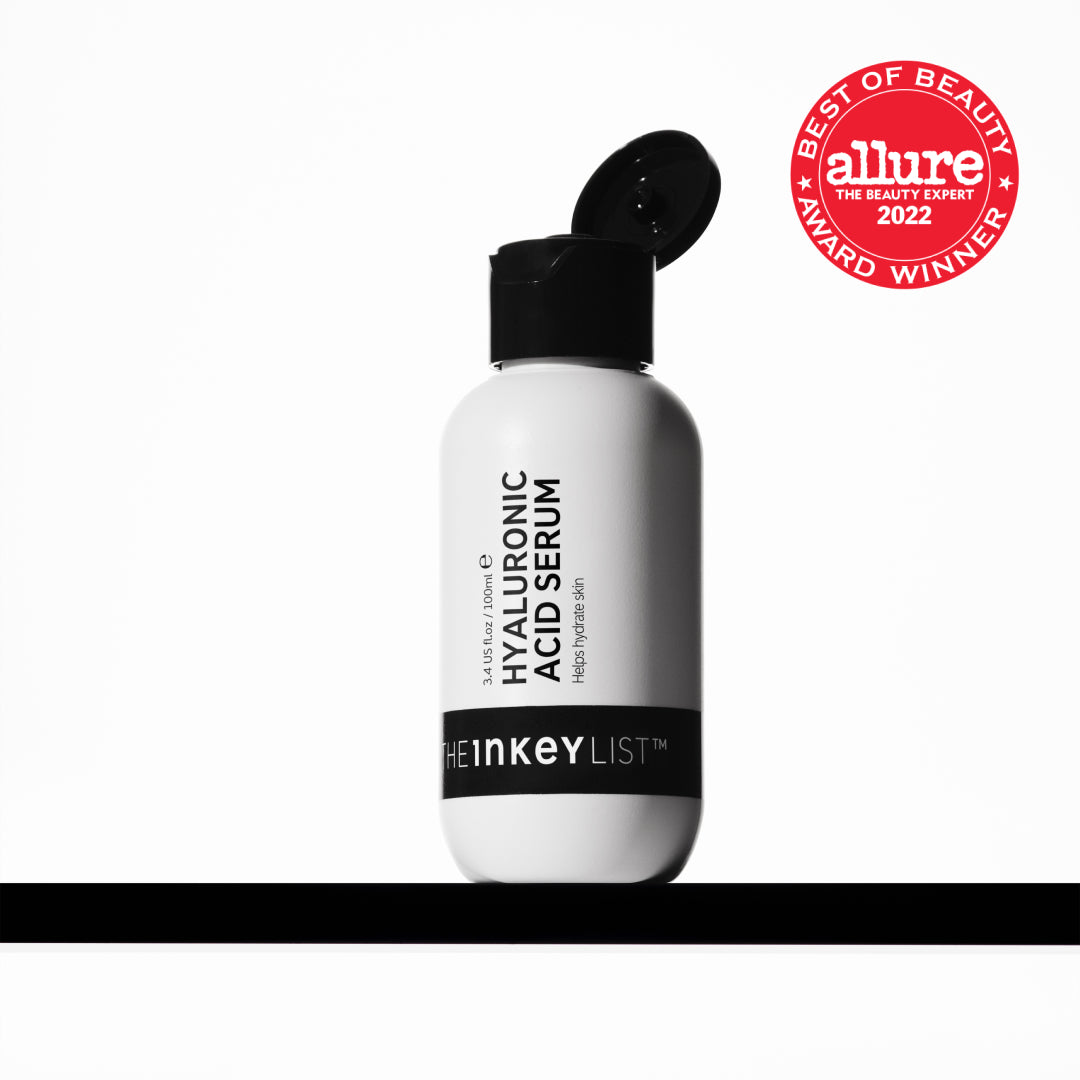
Sodium hyaluronate is the sodium salt of hyaluronic acid. Chemically it is the same molecule with a sodium ion attached, and once it is dissolved in a serum or sitting on your skin, the two behave in almost exactly the same way. The difference that matters is not acid versus salt; it is molecular weight, and the name on the label tells you nothing about that. You will often read that sodium hyaluronate is 'smaller' and 'penetrates deeper' than hyaluronic acid. That claim does not hold up, and knowing why makes ingredient lists much easier to read.
What Is the Difference Between Sodium Hyaluronate and Hyaluronic Acid?
Hyaluronic acid, also called hyaluronan, is a long chain of two sugars repeated over and over: glucuronic acid and N-acetylglucosamine. Each repeat carries one acid group. In sodium hyaluronate, the hydrogen on that acid group has been swapped for a sodium ion. That is the whole difference.
In the body, most hyaluronic acid already exists in this salt-like form. Its acid groups give up their hydrogen at a pH of around 3, so at the pH of skin and of most water-based serums the majority of the molecule is ionised whichever name went on the label. Your skin does not much care which version came out of the bottle.
Sodium hyaluronate is not a cheaper substitute for hyaluronic acid. It is hyaluronic acid in the form chemists prefer to work with.
Why Do Most Products Use Sodium Hyaluronate?
Practicality. Commercial hyaluronic acid is made by bacterial fermentation, then purified and dried, and it is usually isolated as sodium hyaluronate. The salt is a stable white powder that dissolves readily in water and is easier to handle and store. Formulators buy it in that form, so that is what the ingredient list has to say.
The catalogue reflects this. Of the 120 products on the site with a full ingredient list, 35 contain at least one form of hyaluronic acid. Sodium hyaluronate appears in 25 of them, while plain 'Hyaluronic Acid' appears in nine, sometimes alongside the salt.
The Ordinary's Hyaluronic Acid 2% + B5 (with Ceramides) is a good example. The product is named after hyaluronic acid, yet no ingredient called 'Hyaluronic Acid' appears on its list. It contains sodium hyaluronate, hydrolysed hyaluronic acid and sodium hyaluronate crosspolymer instead. That is not a trick; it is simply how the ingredients are named.
The site's own ingredient database files sodium hyaluronate under hyaluronic acid for the same reason. When you see all products containing hyaluronic acid on the site, the salt is counted too.
Is Sodium Hyaluronate Smaller? The Myth
This is the claim you will see most often: sodium hyaluronate has a lower molecular weight, so it penetrates deeper, so it is better. The first part is technically true and practically meaningless, and the rest does not follow.
Each repeating unit of hyaluronic acid weighs about 379 daltons. Swapping hydrogen for sodium adds about 22 more, roughly 6%. A typical high-weight chain contains thousands of these units, so the sodium does nothing to change how large the molecule is in any way that matters to skin.
What really sets the size is processing. Sodium hyaluronate can be made as a long chain of well over a million daltons or broken down into fragments of a few thousand. The INCI name 'Sodium Hyaluronate' covers that whole range. A serum that lists only sodium hyaluronate could be using a large, surface-sitting molecule or a much smaller one, and you cannot tell from the label.
We think the myth persists because it gives a tidy answer to a real question. Molecular weight does matter. It just isn't the sodium that decides it.
Molecular Weight Is the Difference That Matters
Hyaluronic acid works as a humectant: it binds water and holds it in the upper layers of skin. How it does that depends on the size of the molecule.
High-molecular-weight forms, roughly above 1,000 kDa, are too large to get into the skin. They sit on the surface, forming a light film that holds water and reduces moisture loss. This is the smooth, slightly tacky feel of a classic HA serum.
Low-molecular-weight forms, under about 50 kDa, can move into the outer layers of the epidermis. The site's data notes that hydrolysed sodium hyaluronate is typically around 10 kDa, compared with several hundred to a few thousand kDa for standard sodium hyaluronate.
The best-known comparison is a 2011 study in the Journal of Drugs in Dermatology, which tested creams containing 0.1% hyaluronic acid at five different molecular weights over 60 days. All of them improved hydration and elasticity compared with the start of the study. The lower-weight versions were linked with a greater reduction in wrinkle depth. It was a relatively short study and the effects were modest, so it supports using a mix of sizes rather than proving one is best.
There is a caveat at the small end. Laboratory work on skin models suggests that very small fragments, under around 50 kDa, can act as signalling molecules and trigger mild inflammation. The site's data flags this for hydrolysed forms, while noting that it has not been consistently shown in real skin at cosmetic concentrations. In practice, it is a reason for very reactive or barrier-damaged skin to patch test a 'multi-molecular' serum, not a reason to avoid one.
The Other Names You'll See on a Label
Hyaluronic acid comes in more forms than the two in the title. These are the ones in the catalogue.
Sodium hyaluronate and hyaluronic acid. The standard forms. Molecular weight not stated; often, but not always, the larger sizes.
Hydrolysed hyaluronic acid and hydrolysed sodium hyaluronate. 'Hydrolysed' means the chain has been deliberately broken into smaller pieces, so these are reliably low-molecular-weight. On American-style labels it is spelt 'hydrolyzed'.
Sodium hyaluronate crosspolymer. Chains of hyaluronic acid bonded together into a mesh. It forms a water-holding gel on the surface and lasts longer than a single chain. The Ordinary uses it as the 'HA' in its Lactic Acid 5% + HA and mandelic acid serums.
Zinc hydrolysed hyaluronate. A small hyaluronic fragment paired with zinc, found in The Inkey List's 360 Skin Clearing Serum. The zinc is there for oily and blemish-prone skin.
If you want hydration at more than one level, the most useful signal on a label is not 'sodium' but a combination: a standard form plus a hydrolysed form or a crosspolymer. The Inkey List's Ectoin Hydro-Barrier Serum lists four separate forms, the most of any product in the catalogue.
Does the Percentage on the Front Mean Anything?
Less than it looks. Brands do not have to explain how a headline figure such as '2% hyaluronic acid' is calculated. It may refer to a branded complex, a solution of HA in water, or a total across several forms. Two serums at '2%' can contain quite different amounts of the molecule itself.
More is not necessarily better either. The site's data puts typical use at 0.1–2%, and hyaluronic acid works at low concentrations. Where it sits on the ingredient list, and which forms sit alongside it, will tell you more than the number on the box.
Who Is It For, and How Should You Use It?
Almost everyone. The site's data rates hyaluronic acid as low risk for irritation, clogged pores and purging, suitable for all skin types and safe in pregnancy. Sodium hyaluronate carries the same profile, because it is the same ingredient.
Apply it to damp skin. Humectants need water to hold. A hyaluronic serum on dry skin in a dry, heated room has less to work with.
Seal it in. Follow with a moisturiser containing emollients and occlusives so the water stays where you put it. The hyaluronic acid guide covers this in more detail.
Don't overlook glycerin. Glycerin is a cheaper, better-studied humectant that does a similar job, and it sits near the top of most moisturisers already. The glycerin guide explains why it is often the more important of the two.
Layer it freely. Hyaluronic acid has no known conflicts with common actives, so it fits alongside retinoids, acids and vitamin C. The layering actives guide explains where it sits in the order.
Products Worth Considering
All prices are RRPs from the site's catalogue.
The Inkey List's Hyaluronic Acid Serum (around £9.00 for 30ml) lists sodium hyaluronate third and hyaluronic acid further down, alongside glycerin and two peptides. It is a short, simple formula. It also comes in 60ml (£16.00) and a 100ml supersize (£22.00), which brings the cost per millilitre down from 30p to 22p.
The Ordinary's Hyaluronic Acid 2% + B5 (with Ceramides) (around £8.80 for 30ml) combines three forms of hyaluronic acid with panthenol and skin-identical lipids. The Original Formulation (around £7.90) has two forms and no ceramides.
The Inkey List's Ectoin Hydro-Barrier Serum (around £15.00 for 30ml) has the broadest spread of hyaluronic forms in the catalogue, plus ectoin, panthenol and ceramide NP. It suits dry or barrier-stressed skin that wants more than hydration alone.
If you would rather get your hyaluronic acid from a moisturiser, The Ordinary's Natural Moisturizing Factors + HA (around £6.10 for 30ml) pairs glycerin and sodium hyaluronate with amino acids, sodium PCA and urea, which mimic the skin's own moisturising factors. For many people, this does the job of a separate serum.
You can browse the wider serum and moisturiser ranges in the shop.
Common Mistakes
Paying more for 'pure hyaluronic acid'. A product that lists hyaluronic acid rather than sodium hyaluronate is not stronger or purer. The two are interchangeable for skin.
Assuming 'sodium hyaluronate' means low molecular weight. It doesn't. Look for 'hydrolysed' if you want the smaller fragments.
Treating 'HA' in a product name as a headline ingredient. In many acid serums, the HA is a small amount of crosspolymer added for slip and comfort. In The Ordinary's Alpha Arbutin 2% + HA, it is hydrolysed sodium hyaluronate. Both are useful, but neither turns an exfoliant into a hydrating serum.
Stacking several hyaluronic serums. One well-formulated product, plus a decent moisturiser, is enough. The skincare routine for dry skin shows how few steps you need.
Frequently Asked Questions
Is sodium hyaluronate the same as hyaluronic acid? Effectively, yes. Sodium hyaluronate is the sodium salt of hyaluronic acid. Once dissolved in a serum or on skin, the two behave almost identically.
Which is better, sodium hyaluronate or hyaluronic acid? Neither. The difference that affects results is molecular weight, which the name does not tell you. A mix of sizes, such as a standard form plus a hydrolysed form, covers both surface and deeper hydration.
Does sodium hyaluronate penetrate deeper than hyaluronic acid? Not because of the sodium. The sodium ion adds only about 6% to the weight of each repeating unit. Penetration depends on chain length, which is set during manufacturing.
Why do products called 'hyaluronic acid' list sodium hyaluronate? Because commercial hyaluronic acid is usually made and sold as the sodium salt. It is more stable and easier to dissolve, so it is the form formulators use.
Is sodium hyaluronate safe in pregnancy? The site's data rates hyaluronic acid, including its sodium salt, as safe in pregnancy. The pregnancy-safe skincare guide covers the rest of a routine. Check with your midwife, GP or pharmacist if you are unsure.
Can sodium hyaluronate cause breakouts? It is rated low risk for clogged pores and purging in the site's data. If a hyaluronic serum seems to break you out, the cause is more likely another ingredient in the formula. See all products containing hyaluronic acid for the full range on the site.